

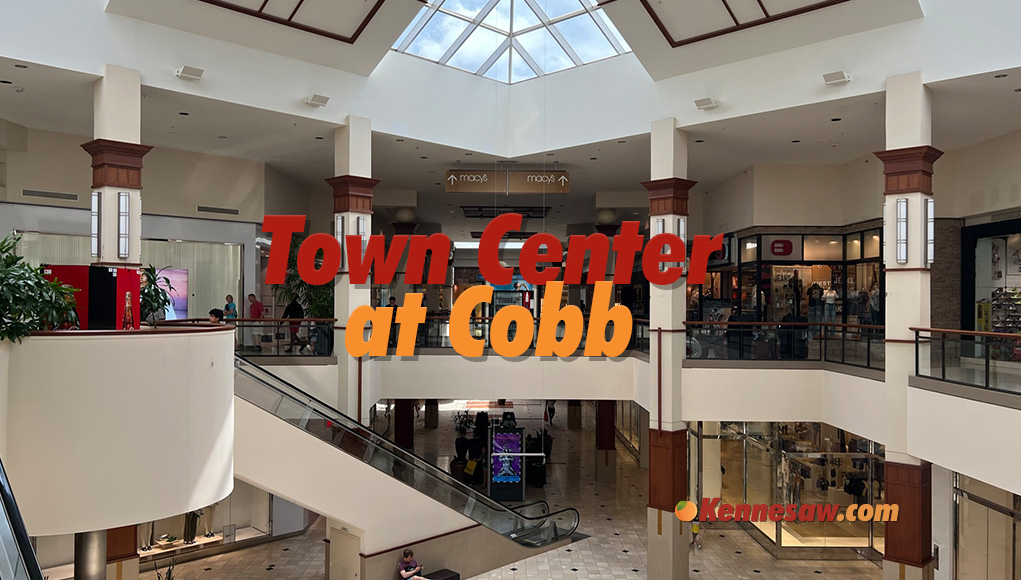
Town Center at Cobb has changed owners again. An affiliate of Atlanta based The Ardent Companies acquired the central portion of Town Center at Cobb through a public foreclosure auction on July 7, 2026. The recorded bid was approximately $51.75 million, nearly $20 million below the price Kohan Retail Investment Group paid three years earlier.
The transaction gives an experienced real estate investment and lending firm control of the mall’s troubled core. It also opens a new chapter for one of Cobb County’s largest commercial properties, though Ardent has not announced what it plans to do with it.

From Regional Powerhouse to Foreclosure
Town Center at Cobb opened in February 1986 on land that had been largely rural only a few years earlier. Cadillac Fairview developed the mall with Rich’s, Macy’s and Sears as its original department stores. Mervyn’s arrived later that year, and a Parisian wing followed in 1992. At its peak, the mall contained about 220 stores and five department store anchors, which was an impressive amount of retail under one roof.
Simon Property Group eventually controlled the central mall property. Its ownership grew from earlier corporate acquisitions and mall portfolio deals, so an exact acquisition price is not known. By 2016, the mall was valued at approximately $300 million. That number says plenty about the property’s former position and even more about the size of the decline that followed.
Simon financed the mall through a commercial mortgage package issued in 2012. The original financing was reported at $200 million, with approximately $166.7 million remaining against the central retail property when the loan failed.
The lenders placed the mall on the courthouse auction block in February 2021 with an opening bid of $130.4 million. No outside buyer bid on it. Deutsche Bank, acting for the lenders and investors behind the mortgage, took possession after the auction. The foreclosure produced a reported loan loss of approximately $96.5 million.
That was the first major financial collapse. It would not be the last.

Kohan Paid $71 Million in 2023
Kohan Retail Investment Group purchased the central portion of Town Center at Cobb from the lender group in January 2023 for $71 million. The New York firm obtained a $42 million acquisition loan, meaning Kohan likely invested about $29 million through equity or additional financing before closing costs and immediate property expenses.
Kohan specializes in distressed malls, often buying properties after larger institutional owners and lenders have decided to leave. Town Center still reported occupancy above 90 percent at the time of the purchase, though tenant sales had already declined and several national retailers had departed.
The situation deteriorated quickly.
The mall temporarily closed in January 2025 after Georgia Power disconnected electricity over delinquent bills. Kohan also owed nearly $1 million in property taxes, placing the mall at risk of a tax auction before the balance was paid. Belk closed its department store in February 2025, leaving JCPenney and two Macy’s stores as the remaining operating anchors.
A Gwinnett County judge placed the property into receivership in February 2025. AFF V Noonday LP, an Ardent affiliate and Kohan’s lender, paid overdue obligations and placed JLL in control of mall operations.
Kohan’s $46.7 million loan from Ardent matured on February 15, 2026. Kohan did not repay or refinance it, clearing the way for foreclosure.

What the $51.75 Million Sale Means
The July 7 transaction was a public foreclosure auction conducted under Georgia’s sale under power process. It was not a conventional deal in which Ardent negotiated a price with Kohan and handed over $51.75 million.
Ardent was already the lender. Kohan owed it approximately $46.7 million, plus interest, legal charges, receiver expenses and other costs. An Ardent affiliated company submitted the winning bid of $51.75 million. No competing bidder has been publicly identified.
Lenders can use a credit bid at foreclosure, applying the debt owed to them against the auction price. That means Ardent probably did not pay the entire $51.75 million in new cash. The amount above the loan principal likely represented accumulated interest and expenses.
Kohan also did not receive $51.75 million from the transaction. Unless a foreclosure produces money beyond the loan balance, interest, legal expenses and other claims, the former owner receives nothing from the auction.
The available figures suggest Kohan lost millions on Town Center. It may have recovered some money through rental income, management fees or refinancing proceeds, but it paid $71 million, borrowed $42 million at acquisition and ultimately surrendered the property after defaulting on a later $46.7 million loan.
A Mall Divided Among Several Owners
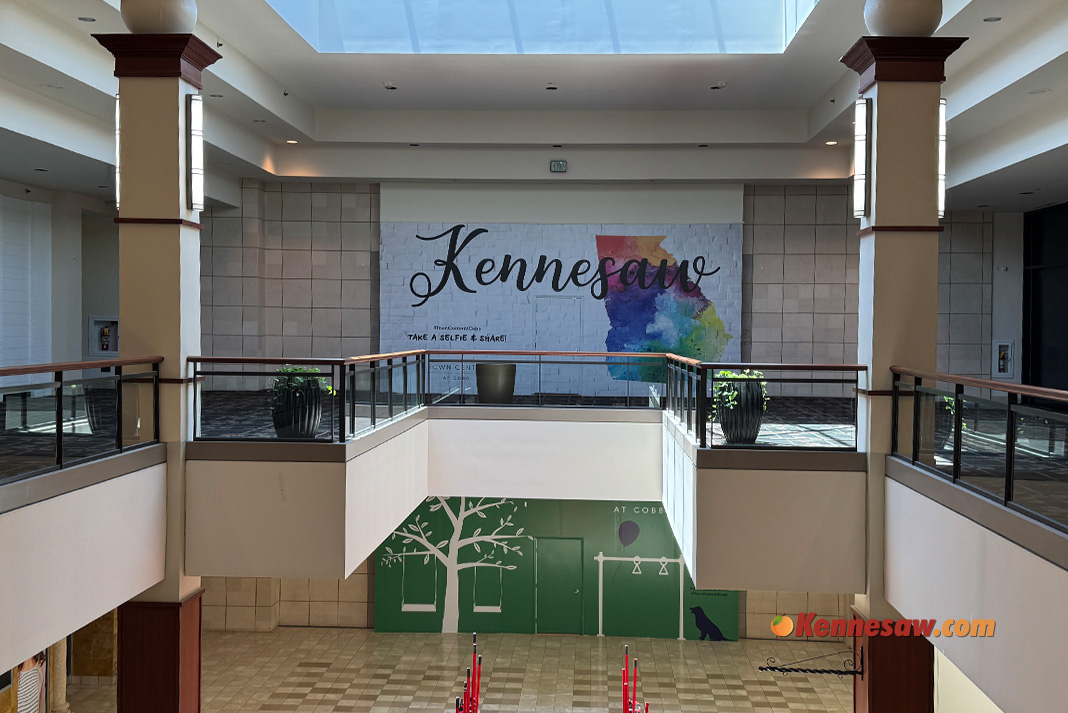
Ardent did not acquire the entire 1.3 million square foot mall complex.
The foreclosure covered the approximately 560,000 square feet controlled by the central mall owner. Town Center occupies about 92 acres in total, but JCPenney and Macy’s own separate buildings and parcels. Those ownership divisions limit how much of the property Ardent can redesign without agreements or additional purchases.
The former Sears property is also separately owned. Sears operated at Town Center from the mall’s 1986 opening until August 2020. Transformco, the company controlling much of the former Sears real estate portfolio, retained the building after the store closed.
On March 4, 2025, Transformco sold the approximately 13 acre Sears parcel to Ernest West Village LLC for $9 million. The transaction included the two level department store and its surrounding parking.
Ernest West Village later filed plans with Cobb County for landscape and hardscape renovations covering the 12.88 acre property. Business records connect the purchaser’s address with CFC of Georgia, the company behind Nam Dae Mun Farmers Market. Those records point toward an international grocery operation at the former Sears, though an opening date has not been announced. A grocery redevelopment there could bring fresh traffic to the property, but it could also complicate any plan involving demolition or a complete redesign of the western side of the mall.
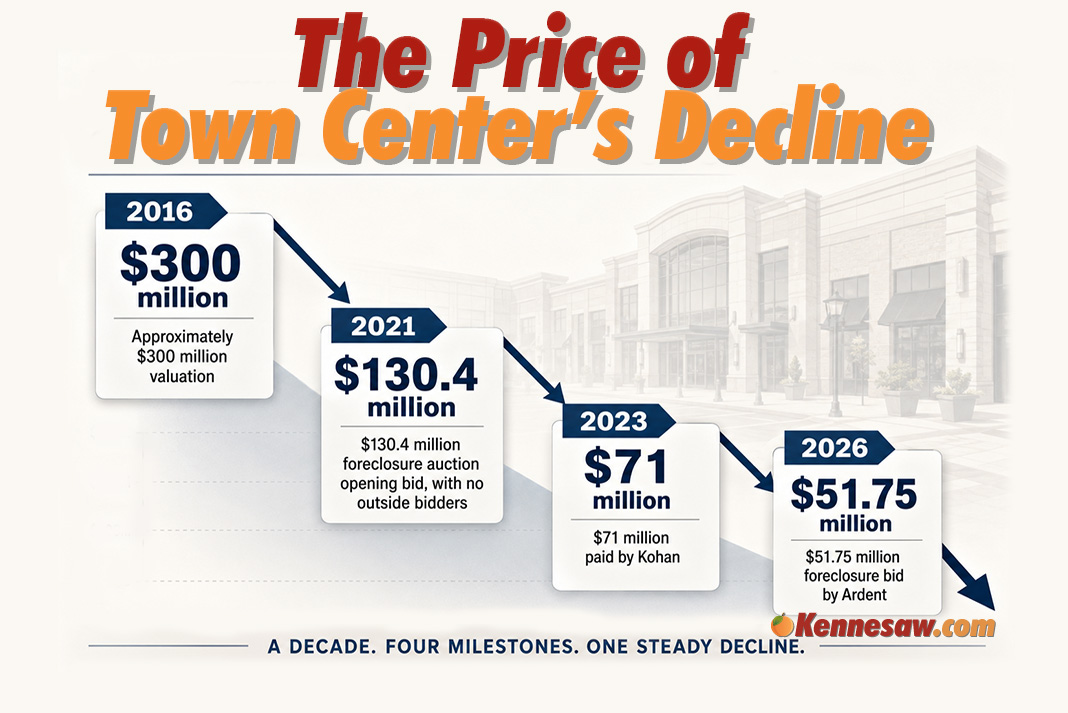
Few figures explain Town Center’s decline better than its changing price tag:
2016: Approximately $300 million valuation under Simon Property Group
2021: $130.4 million foreclosure auction opening bid, with no outside bidders Deutsche Bank takes possession
2023: $71 million paid by Kohan Retail Investment Group
2026: $51.75 million foreclosure bid by The Ardent Companies
The 2026 figure is about 27 percent below Kohan’s purchase price and roughly one sixth of the property’s 2016 value.
Those numbers do not compare identical transactions. The $300 million amount was a valuation, the $130.4 million figure was a failed auction threshold, the $71 million transaction was a conventional purchase from lenders, and the $51.75 million figure was a lender credit bid.
Still, the direction is hard to miss. Town Center went from institutional trophy property to distressed purchase, then from distressed purchase to another foreclosure in less than four decades.

What Ardent Has Done With Other Aging Retail Properties
Ardent is a privately held Atlanta real estate firm founded in 2012. Its commercial division acquires properties, provides real estate loans and restructures troubled investments. Partner Scott Werbel previously acquired shopping centers and nonperforming retail loans and led the restructuring, foreclosure and sale of nearly $400 million in distressed assets before joining Ardent.
That background separates Ardent from Kohan. Kohan became known for purchasing declining enclosed malls and operating them with limited investment. Ardent has a record of dividing underused retail sites into new parcels, adding housing and recruiting developers or tenants for individual sections.
East Village in Roswell
Ardent acquired the 268,000 square foot East Village shopping center on Holcomb Bridge Road after its former Target anchor closed. The company relocated Dollar Tree, split the property into residential and retail parcels and sold the housing land to another developer.
More than 400 apartments and townhomes were developed on former retail and parking areas. Ardent leased the remaining commercial property to new businesses, reached 100 percent retail occupancy and sold its final retail parcel in January 2026, ending an approximately five year investment.
East Village is the clearest completed example of Ardent’s retail strategy. The old shopping center did not receive a cosmetic facelift and another round of hopeful leasing signs. Its land was divided, housing replaced dead space, viable retail remained, and Ardent eventually sold the pieces.
Seminole Towne Center in Florida
Ardent purchased 76 acres at the shuttered Seminole Towne Center in Sanford, Florida, for $17.5 million in March 2025. The 1.1 million square foot mall had previously been owned by Kohen and another distressed mall investor.
The redevelopment includes new retail, apartments, and a hotel. City reports show Ardent advancing land use approvals, recruiting developers and acquiring additional control, including the former JCPenney property. Plans also place a new Costco on the former Macy’s site. Several independently owned anchors are expected to remain.
A Costco is highly unlikely at Town Center at Cobb because an existing Costco operates nearby on Barrett Parkway. The useful comparison is Ardent’s method of closing obsolete mall sections, gaining control of strategic parcels, preserving useful anchors, and replacing excess retail with new uses.
Perimeter Pointe in Sandy Springs
Ardent paid approximately $48 million for Perimeter Pointe in January 2026. The 360,000 square foot shopping center occupies about 30 acres beside the Sandy Springs MARTA station.
Ardent plans to fill vacancies, change the retail mix, improve pedestrian connections, and add apartments on underused land. The project is still in its early phase, so its final form and financial result remain unknown.
Together, the three properties reveal a consistent playbook where Ardent acquires troubled or underused commercial land, separates it into manageable pieces, retains retail that still earns money, and adds housing or other development where parking lots and empty buildings no longer make financial sense.
What Could Happen at Town Center
Ardent has not announced any redevelopment plans for Town Center at Cobb. No confirmed proposal exists for apartments, hotels, an arena, demolition, or an open air shopping district.
The firm’s previous projects make several outcomes plausible.
Ardent could continue operating the enclosed mall while improving leasing and basic maintenance in the short term. Long term, it could demolish vacant sections, split the land into development parcels, and sell some of those parcels to apartment, hotel, or retail developers. It could also retain stronger mall entrances and existing tenants while replacing weaker wings with restaurants, housing, and smaller retail buildings.
A major entertainment attraction or sports arena is conceivable on a property of this size, but there is no evidence connecting Ardent or Town Center to that type of proposal. The separate ownership of Macy’s, JCPenney, and the former Sears would shape every major plan. Ardent would need purchase agreements, amended easements, or cooperation from neighboring owners for shared roads, utilities, parking, and construction access.
That can happen. Ardent later purchased an additional anchor parcel at Seminole Towne Center after buying the mall core. It can also take time, and large mall redevelopments are measured in years rather than grand opening weekends.
A Better Owner Does Not Mean an Immediate Transformation
Ardent has redevelopment experience, access to capital, and direct knowledge of Town Center’s finances. Its affiliate had been involved as lender and receiver for more than a year before the auction. It had already seen the bills, leases, repair problems, and tenant conditions.
That knowledge could allow Ardent to move faster than a completely new buyer. It also means the company understood the property’s problems before taking title.
Town Center remains open, and ownership changes after foreclosure do not normally force tenants to leave immediately. Ardent has a financial reason to collect rent and keep the property operating while it decides which portions have a future.
The larger question is no longer about how long Kohan can keep the lights on. The new question is how much of the old 1986 mall will remain in the next version of the Town Center property.